Understanding Springs – Extension Springs
While many applications require springs that dampen force and perform a pushing action, others require springs that oppose extension by pulling themselves back together. Extension springs, also called tension springs, are found in many applications, such as:
- Automotive Components – Used in car interiors for mechanisms like seat recliners or throttle return springs.
- Garage Doors – Provide the counterbalance force to help lift and lower the door smoothly.
- Trampolines – Connect the jumping mat to the frame, storing energy when stretched and releasing it for bounce.
- Farm Machinery – Found in levers and linkages to maintain tension or return parts to their original position.
- Industrial Equipment – Used in conveyor systems or assembly lines to maintain tension on belts or moving parts.
HOW DOES AN EXTENSION SPRING WORK?
Extension springs are typically made with initial tension, which causes the coils to pull tightly together when in the unloaded position. The extension spring deflects only when it receives a load greater than the amount of initial tension.

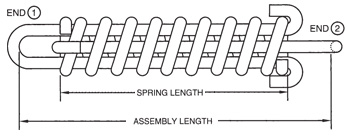
Extension springs have hooks on their ends to attach them to the application. Various hook styles and configurations are used depending on the particular application.
Common hook/loop types include:

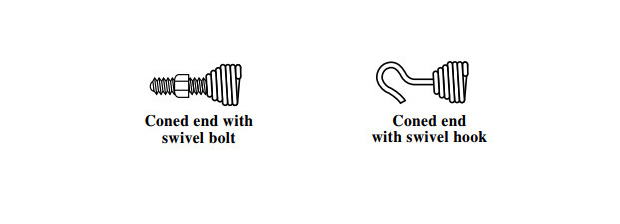
Extension springs can also be designed with coned ends and inserts, or an insert that threads into the spring. These variations provide different attachment options and improved performance for applications that require secure connections or adjustable tension.
Furthermore, unlike compression springs, extension springs do not have a solid stop to prevent overloading. For these reasons, design stresses are generally lower for extension than compression springs. A special type of extension spring, called a drawbar spring, has a solid stop. It is essentially a compression spring with hooks, that is used as an extension spring, but the potential to overload it has been mitigated.