
Understanding Springs – Torsion Springs
A torsion spring is a type of mechanical spring that works by twisting rather than compressing or extending. It stores energy when its ends are rotated around the spring’s axis, creating torque that resists the twisting motion. These springs are commonly used in applications where rotational force is needed, such as on garage doors, industrial machinery, and hinges.

They are also used as couplings between concentric shafts such as in a motor pump assembly. Torsion springs are generally mounted around a shaft or arbor and must be supported at three or more points.
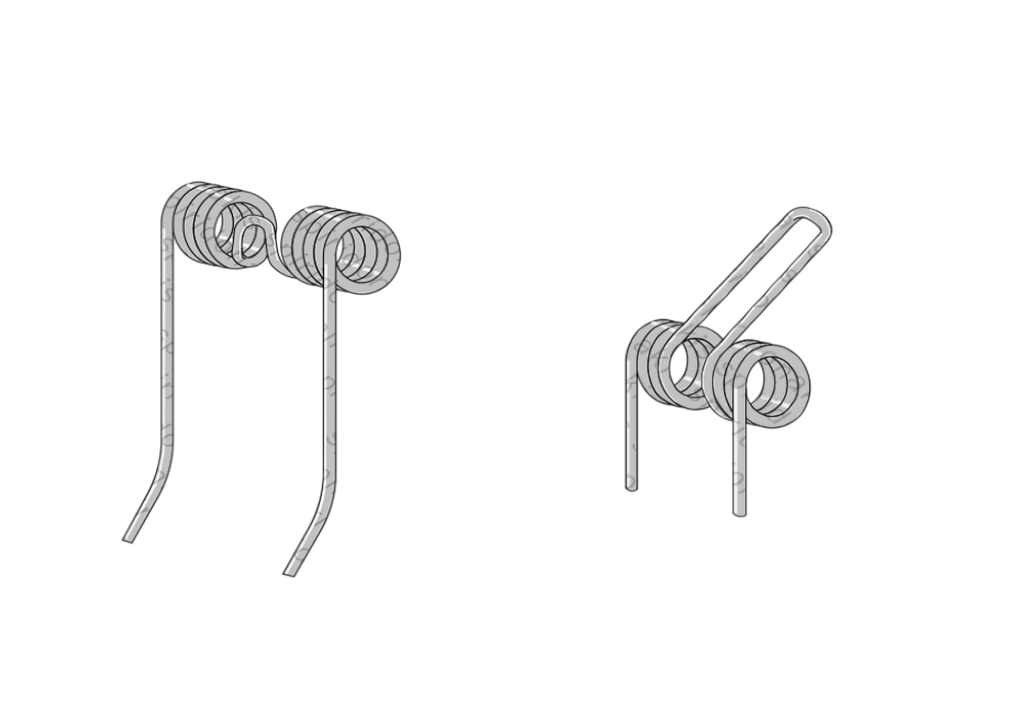
Torsion springs can also have two bodies. A double torsion spring is essentially two torsion springs connected by a central bridge, with coils wound in opposite directions. This design allows for balanced torque and greater flexibility in applications where forces need to be applied in two directions or where space constraints require a compact solution.
Torsion springs are stressed in bending. If possible, a torsion spring should always be loaded in a direction that causes the body to wind up, decreasing diameter. The residual forming stresses are favorable in this direction, but unfavorable when the spring is loaded in the unwind direction, increasing the body diameter. Unless there are unfavorable residual stresses in the end bends, spring makers normally heat-treat these springs at a low temperature to stabilize the end positions rather than fully stress-relieve them. If the direction of loading tends to increase body diameter, the spring maker should be advised to stress-relieve the springs.